



Researchers Discover Role of Glycogen Synthesis in Regulating Adipose Tissue Thermogenesis and Hypermetabolism Post-Burn Injury
The research team led by Professor CHEN Yan at the Shanghai Institute of Nutrition and Health (SINH), Chinese Academy of Sciences, published a research paper titled "Blocking glycogen synthase 1 in white adipose tissue alleviates hypermetabolism following severe burn injury through inhibition of JAK2 by UDPG" in the international academic journal Cell Reports on Nov. 19, 2025.
This study discovered that blocking glycogen synthase 1 (GYS1) increases uridine diphosphate glucose (UDPG), which directly binds to the JAK2 protein, thereby inhibiting interleukin-6 (IL-6) induced JAK2-STAT3 signaling post-burn injury. This inhibition suppresses thermogenesis in white adipose tissue and ameliorates the body's hypermetabolic state.

Hypermetabolism, a state characterized by a significant increase in resting energy expenditure, is a hallmark response to critical illnesses, including severe burns, cancer cachexia, and sepsis. This condition is characterized by metabolic imbalance, manifesting as abnormal accumulation of circulating energy substrates (such as free fatty acids) and uncontrolled catabolism in adipose tissue and skeletal muscle. These alterations lead to systemic metabolic dysfunction, exacerbated inflammation, multiple organ failure, and poor clinical outcomes.
A key driver of the hypermetabolic state post-burn is the "browning" of white adipose tissue. Although UCP1-mediated thermogenesis is crucial for adaptive thermoregulation, its pathological activation after burns leads to excessive metabolic consumption. Studies indicate this process is significantly promoted by bone marrow-derived IL-6. This white adipose tissue browning is further associated with burn-induced hepatic steatosis.
GYS1 is involved in glycogen synthesis. The researchers previously reported that adipose tissue-specific knockout of the Gys1 gene attenuated the browning response under cold or β3-adrenergic agonist stimulation. However, the role of GYS1 in burn-induced white adipose tissue browning remained unknown.
The research team found that GYS1 expression was significantly upregulated in the white adipose tissue of both mice and humans after burn injury. Adipose tissue-specific Gys1 knockout effectively suppressed burn-induced white adipose tissue browning and lipolysis, improved hepatic steatosis, and significantly increased survival rates. Notably, Gys1 knockout did not affect the normal thermogenic function of brown adipose tissue nor did it alleviate muscle wasting.
Mechanistically, the researchers found that Gys1 deletion led to substantial intracellular accumulation of UDPG. This accumulated UDPG effectively inhibited IL-6-induced JAK2-STAT3 signaling pathway activation through a unique mechanism independent of the β3-adrenergic or P2Y14 receptor pathways. Using molecular docking and surface plasmon resonance experiments, the team confirmed a direct and specific binding interaction between UDPG and the JAK2 protein.
More importantly, researchers administered MZ-101, a specific small-molecule inhibitor of GYS1, for burn treatment. This successfully replicated the effects of genetic knockout, significantly elevating UDPG levels in adipose tissue, recapitulating various phenotypic improvements including suppressed white adipose tissue browning and improved hepatic steatosis, and ultimately significantly enhancing the survival rate of the experimental burn animals.
In summary, this study systematically elucidated for the first time the central regulatory role of the GYS1-UDPG-JAK2-STAT3 signaling axis in pathological white adipose tissue browning post-burn injury. It also innovatively proposed that targeted inhibition of GYS1 could serve as a novel therapeutic strategy for treating burn-induced hypermetabolism. This discovery not only deepened the understanding of the mechanisms underlying post-burn metabolic disorders but also provided a new potential therapeutic target for clinical intervention.
Professor CHEN Yan from SINH is the corresponding author of the paper. PhD student ZHOU Shixuan is the first author. The research was supported by grants from the National Key R&D Program of China, the Key Program of the National Natural Science Foundation of China, and the Shanghai Municipal Science and Technology Major Project. It also received support from the Analytical Technology Platform and the Experimental Animal Technology Platform of the SINH Core Facility Center.
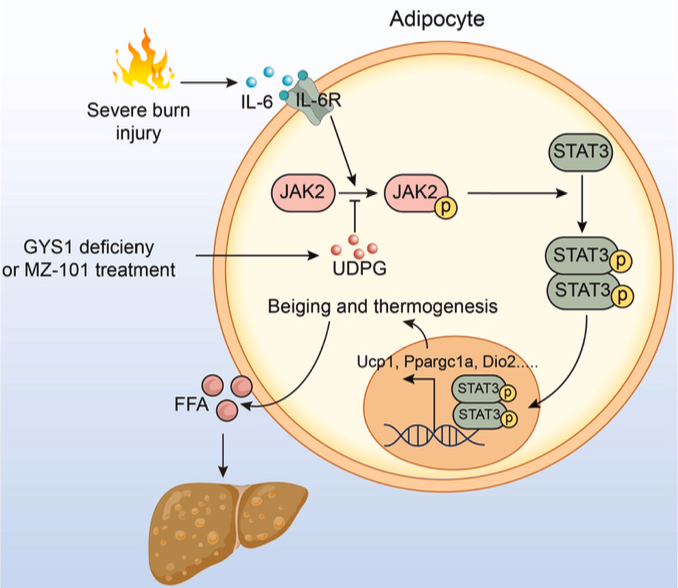
Molecular mechanism by which blocking GYS1 inhibits adipose tissue thermogenesis and ameliorates hypermetabolism after burn injury. (Image by Prof. CHEN Yan’s group)
Article Link: https://www.cell.com/cell-reports/fulltext/S2211-1247(25)01349-X
Scientific Contact:
Prof. CHEN Yan
Shanghai Institute of Nutrition and Health,
Chinese Academy of Sciences
Email: ychen3@sinh.ac.cn
Media Contact:
WANG Jin
Shanghai Institute of Nutrition and Health,
Chinese Academy of Sciences
Email: wangjin01@sinh.ac.cn
