



SINH-CKB Teams Reveal Protective Associations Between Odd-Chain Fatty Acids and Cardiometabolic Diseases in Chinese and Updated Global Meta-Analysis
SINH-CKB Teams Reveal Protective Associations Between Odd-Chain Fatty Acids and Cardiometabolic Diseases in Chinese and Updated Global Meta-Analysis
On September 24, 2025, European Journal of Preventive Cardiology online published a collaborating work by Professor LIN Xu’s team from the Shanghai Institute of Nutrition and Health (SINH), Chinese Academy of Sciences (CAS) and the China Kadoorie Biobank (CKB) study team, entitled “Erythrocyte odd-chain fatty acids and the risk of cardiometabolic diseases: a prospective study and updated meta-analysis”. To the best of our knowledge, this study represented the largest prospective investigation to date in Asian populations about the dietary sources and the beneficial role of odd-chain fatty acids (OCFAs) in cardiometabolic diseases (CMDs) and also validated the findings by an updated meta-analysis integrating 33 additional cohort studies from 14 countries.
Pentadecanoic (15:0) and heptadecanoic (17:0) acids as two major types of OCFAs, have long been considered as biomarkers of dairy fat and showed favorable associations with CMDs like ischaemic heart disease (IHD) and/or diabetes in some Western studies among populations consumed high level of dairy products. However, little is known about dietary sources and the associations between OCFAs and CMDs among people having habitual low dairy consumption like Asians.
By leveraging the large erythrocyte fatty-acid database established by SINH in collaborating with CKB, this study included 8185 Chinese participants (mean age 58.1 years), who attended the 2013-14 resurvey of CKB study. During an approximately 5-year follow-up, 950 incident CMD cases were documented, including 387 IHD, 127 diabetes and 459 stroke.
The key findings included: Firstly, among this Chinese population with low-dairy-consumption, dietary sources of OCFAs varied across 10 regions: in the regions like Qingdao and Harbin with relatively higher dairy intake, dairy products were the major source corelated with erythrocyte OCFA levels; in the coastal region like Haikou with low-dairy consumption, fish/seafood intake was significantly correlated with 17:0 levels; while in some inland regions like Liuzhou and Harbin, fiber-rich grains such as wheat and coarse grains both linked with 15:0 and 17:0 levels.
Secondly, researchers found that compared with the lowest tertile, the highest tertile of 15:0 and 17:0 levels were significantly associated with a lower risk of incident IHD (15:0, adjusted HR=0.72 [95% CI, 0.59-0.89], Ptrend=0.02; 17:0, 0.69 [0.56-0.86], Ptrend=0.009). Moreover, 17:0 level was also inversely associated with incident diabetes (0.41 [0.27-0.62], Ptrend< 0.001).
Thirdly, the findings from the CKB subpopulation were further confirmed by the updated meta-analysis integrating 34 prospective cohort studies in 14 countries across Europe, North America, Oceania and Asia (total n=112,193). Though dairy intake of Chinese only accounted for one-third of that in Western populations, high 15:0 and 17:0 levels were also significantly associated with low diabetes risks, while high 17:0 was significantly associated with low incident IHD and high 15:0 was significantly associated with low incident stroke.
Collectively, despite varied dietary sources and levels, higher levels of OCFAs consistently showed favorable associations against CMDs risks in diverse populations. OCFAs might serve as promising modifiable biomarkers for future precise nutritional assessment and intervention for CMD risk in clinical settings.
Professor LIN Xu in SINH, and Professor CHEN Zhengming in the University of Oxford are the co-corresponding authors; Professor LI Liming in the School of Public Health, Peking University, is a co-senior author. Professor SUN Liang (previously an associate professor in SINH) in Fudan University, doctoral student XU Xinming in Fudan University, Associate Professor DU Huaidong in the University of Oxford, and Associate Professor LU Ling in the Hangzhou Institute for Advanced Study, University of CAS, are co-first authors of this paper.
This study was funded by the “Strategic Priority Research Program” and the Major Project of the Strategic Priority Research Program of CAS, the Ministry of Science and Technology of China and the National Natural Science Foundation of China. The CKB project received funding from the National Key Research and Development Program of China, the National Natural Science Foundation of China, UK Wellcome Trust, British Heart Foundation, UK Medical Research Council, Cancer Research UK, and Kadoorie Charitable Foundation.
Institutional Center for Shared Technologies and Facilities provided platform for fatty acid assessment and High-Performance Storage, while Computing Platform of Bio-Med Big Data Center in SINH provided NODE-SDAP as the secure computing environment for this study.
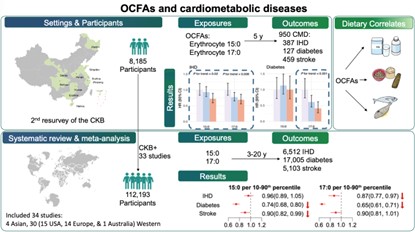
Findings from the China Kadoorie Biobank and the updated global meta-analysis showed that two major odd-chain fatty acids were associated with a lower cardiometabolic disease risk.
(Image provided by Professor LIN Xu’s team)
Paper Link: https://doi.org/10.1093/eurjpc/zwaf601
Scientific Contact:
Prof. LIN Xu
Shanghai Institute of Nutrition and Health,
Chinese Academy of Sciences
Email: xlin@sinh.ac.cn
Media Contact:
WANG Jin
Shanghai Institute of Nutrition and Health,
Chinese Academy of Sciences
Email: wangjin01@sinh.ac.cn
