



Researchers Discover Palmitic Acid Disrupts ICOShi Treg Cells to Promote Obesity Related Metabolic Disorders
A research team led by Prof. LI Yu from the Shanghai Institute of Nutrition and Health, Chinese Academy of Sciences, in collaboration with Profs. ZHANG Chunxiang, BI Yan, and CUI Aoyuan, identified a novel mechanism by which palmitic acid induces CREBZF overactivation, impairing ICOShi Treg-mediated immunosuppression and exacerbating metabolic disturbance in obesity. Entitled "Palmitic acid coordinates impaired visceral adipose ICOShi Treg-mediated immunosuppression and systemic metabolic disturbance during obesity", this study was published online in the Journal of Clinical Investigation on July 23, 2026.
Chronic inflammation causes visceral white adipose tissue (VAT) dysfunction and systemic metabolic disturbance in obesity, yet how the obese microenvironment reshapes the heterogeneity and functional integrity of tissue-resident Treg cells remains largely unexplored.
By performing single‑cell RNA sequencing on VAT from obese mice, the researchers identified two functionally distinct Treg subsets: KLRG1hi and ICOShi. The ICOShi subset exhibited potent immunosuppressive activity, and its frequency and suppressive function were markedly impaired under obese conditions.
Further experiments revealed the transcription factor CREBZF as a critical regulator of ICOShi Treg function. Notably, CREBZF deficiency enhanced both the stability and immunosuppressive activity of these cells, alleviating visceral adipose inflammation. When transferred into Rag1-/- mice, CREBZF‑deficient ICOShi Treg cells more effectively suppressed local inflammation and improved systemic metabolic abnormalities.
Mechanistically, elevated palmitic acid in the obese milieu induced CREBZF expression in ICOShi Treg cells. CREBZF directly interacted with c‑JUN to inhibit AP‑1 transcriptional activity, thereby suppressing Foxp3 activity and ultimately impairing the stability and production of inhibitory cytokines in ICOShi Treg cells.
Importantly, CREBZF expression levels were significantly negatively correlated with FOXP3 as well as the anti-inflammatory cytokines IL-10 and TGFβ in VAT from obese human subjects, suggesting the conservation of this regulatory axis in humans.
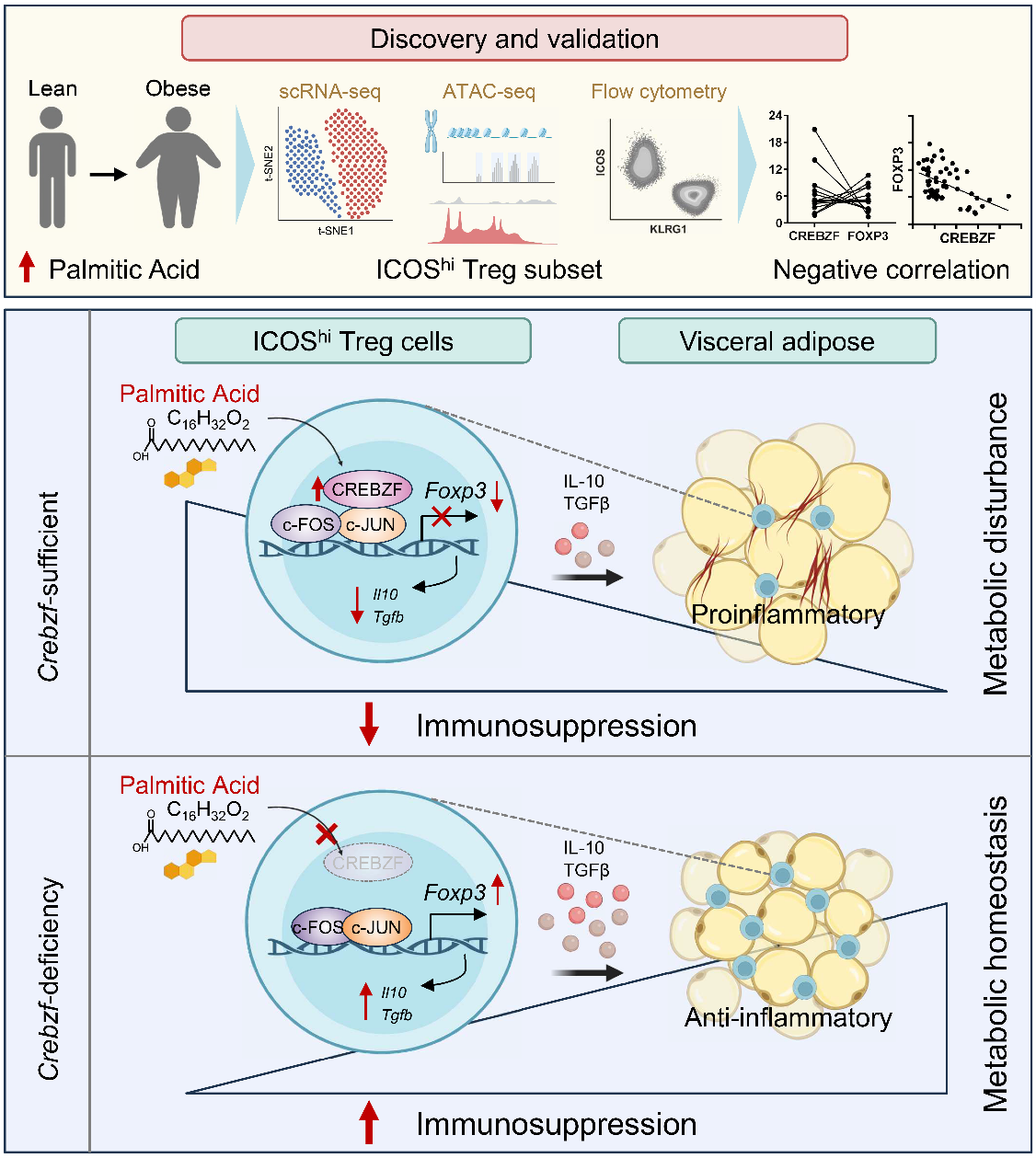
Schematic model illustrating how palmitic acid impairs ICOShi Treg immunosuppression, linking visceral adipose tissue remodeling to systemic metabolic dyshomeostasis. (Image by Prof. LI Yu’s group)
Paper link: https://doi.org/10.1172/jci207089
Scientific Contact:
Prof. LI Yu
Shanghai Institute of Nutrition and Health,
Chinese Academy of Sciences
Email: liyu@sinh.ac.cn
Media Contact:
WANG Jin
Shanghai Institute of Nutrition and Health,
Chinese Academy of Sciences
Email: wangjin01@sinh.ac.cn
