



Ancient Bottleneck of Homo Populations Shown by High-precision Computation and Fossil Evidence
Reconstructing how ancient populations changed in size is essential for understanding where modern humans came from. In 2023, a research team led by Prof. LI Haipeng and collaborators published a new method called the fast infinitesimal time coalescent process (FitCoal) in Science. FitCoal precisely computes the expected site frequency spectrum (SFS), a summary statistic of how common each mutation is. Using it, the team detected a severe bottleneck about 930,000 years ago that nearly drove our ancestors extinct.
In the new study, the team compared FitCoal and mushi because both rely on SFS to infer demography. They ran ten billion coalescent simulations and used the averaged results as the ground truth. Across 215 SFS categories, FitCoal's estimates matched this benchmark in 194 categories (90.2%), differing by at most a single generation elsewhere. By contrast, mushi's estimates deviated by about two orders of magnitude. FitCoal was also dramatically faster, finishing the same calculation in about 0.00013 seconds, versus 1.29 seconds for mushi. The team then simulated genome-wide data conditional on the ancient severe bottleneck. FitCoal recovered the bottleneck whereas mushi failed.
The team also confirmed that there is no significant difference between the inferred bottlenecks in African and non-African populations. Crucially, this genetic signal is echoed by independent fossil and ancient-climate evidence. These include the African fossil gap, the chromosome 2 fusion, sharp Pleistocene climate shifts, and a later rise in brain size. The figure below traces hominin evolution over the past one million years. After the bottleneck, this lineage led to the last common ancestor of Denisovans, Neanderthals, and modern humans.
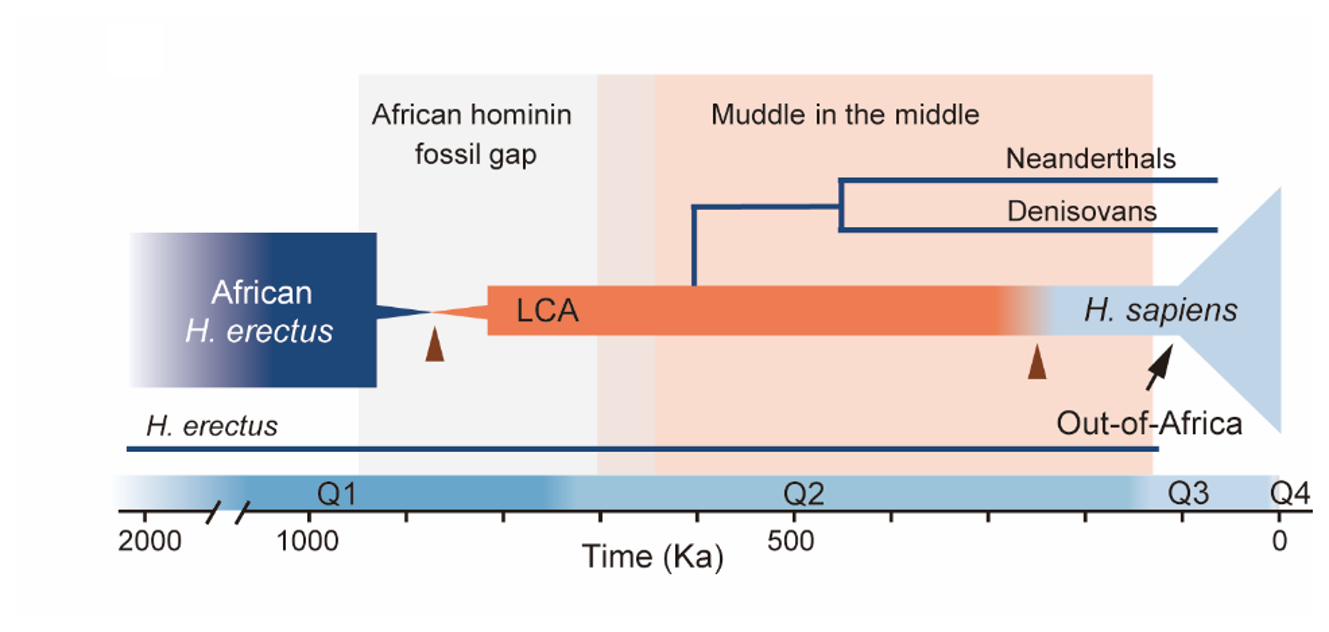
Hominin evolutionary history over the past one million years. (Image provided by Prof. LI Haipeng's group)
Entitled “Severe bottleneck of ancientHomopopulations: Insights from computational modeling and relevant fossil evidence”, this study was published in Molecular Biology and Evolution on July 2, 2026. It was co-led by the Shanghai Institute of Nutrition and Health of the Chinese Academy of Sciences (CAS) and East China Normal University. Collaborators are from Sapienza University of Rome and the University of Florence. ZHOU Sumei and ZHOU Yiwen are co-first authors, while LI Haipeng and PAN Yi-Hsuan are co-corresponding authors.
This work was supported by the National Natural Science Foundation of China, the Eastern Talent Plan Leading Project, and the CAS Youth Interdisciplinary Team.
Links:
MBE Paper: https://doi.org/10.1093/molbev/msag157
2023 Science paper: https://www.science.org/doi/10.1126/science.abq7487
Scientific Contact:
Prof. LI Haipeng
Shanghai Institute of Nutrition and Health,
Chinese Academy of Sciences
Email: lihaipeng@sinh.ac.cn
Media Contact:
WANG Jin
Shanghai Institute of Nutrition and Health,
Chinese Academy of Sciences
Email: wangjin01@sinh.ac.cn
